Why marina shift handovers matter
Marina operations rarely reset when one shift finishes and another begins. A vessel may still be expected to arrive. A berth inspection may remain outstanding. Maintenance work may be open. An issue identified during a Dock Walk may still require action.
The incoming team therefore needs more than a record of what the previous shift completed.
It needs to understand the current operational position.
A good handover answers three questions: What changed? What remains outstanding? What needs attention next?
The objective is continuity. Important operational information should survive the change of shift rather than depending on somebody remembering to mention it.
1. Review vessel movements
Vessel movements affect berth availability, staff priorities and customer expectations. The incoming team should know which movements are complete and which still require operational attention.
2. Review berth status
A berth can appear available administratively while an operational condition makes it unsuitable for an arriving vessel. Handover information should preserve that distinction.
3. Review open Dock Walk issues
A Dock Walk finding should not disappear simply because the person who found it has finished their shift.
The incoming team needs enough context to understand the issue and what has already happened because of it.
4. Review active maintenance
Handover should preserve the state of the issue, not simply repeat that the issue exists.
“Shore-power pedestal B-04 damaged” is useful information. “B-04 isolated, maintenance task open, contractor expected tomorrow morning and berth not to be allocated” gives the next shift much more operational context.
5. Review inspections still due
An unfinished inspection programme should become an explicit part of the handover rather than an assumption that the incoming team will discover what remains.
6. Communicate safety and operational exceptions
7. Record customer or vessel matters requiring follow-up
Operational continuity also affects the customer experience. A customer should not need to explain the same marina issue again simply because a different member of staff is now on duty.
8. Add the context the system cannot know
Structured operational records are important, but they do not contain every piece of useful shift knowledge.
The outgoing operator may know that a contractor has confirmed an arrival time, that a customer has been informed of a temporary berth change, or that a particular issue should be checked again after the tide changes.
That is where handover notes remain valuable.
THE TWO PARTS OF A USEFUL HANDOVER
Operational data + human context
Systems can show what is open, due or outstanding. People can provide the context around what has happened, what has already been discussed and what the next shift needs to understand.
A strong handover brings those two sources of information together.
9. Prioritise exceptions rather than retelling the entire shift
A handover does not need to become a diary of every routine activity carried out during the previous working period.
The most useful information is usually the information that affects what the incoming team needs to do differently.
10. Before completing the handover
From shift log to operational continuity
A written note has value, but handover becomes more useful when the person writing it does not first have to reconstruct the marina's entire operational position.
If berth inspections, vessel movements, Dock Walk findings and maintenance already exist as operational records, those records can provide part of the handover automatically.
The outgoing operator can then concentrate on adding the context that the records alone cannot provide.
MARINACONTROL SHIFT HANDOVER
Current marina state → outstanding work → vessel movements → human context → next shift
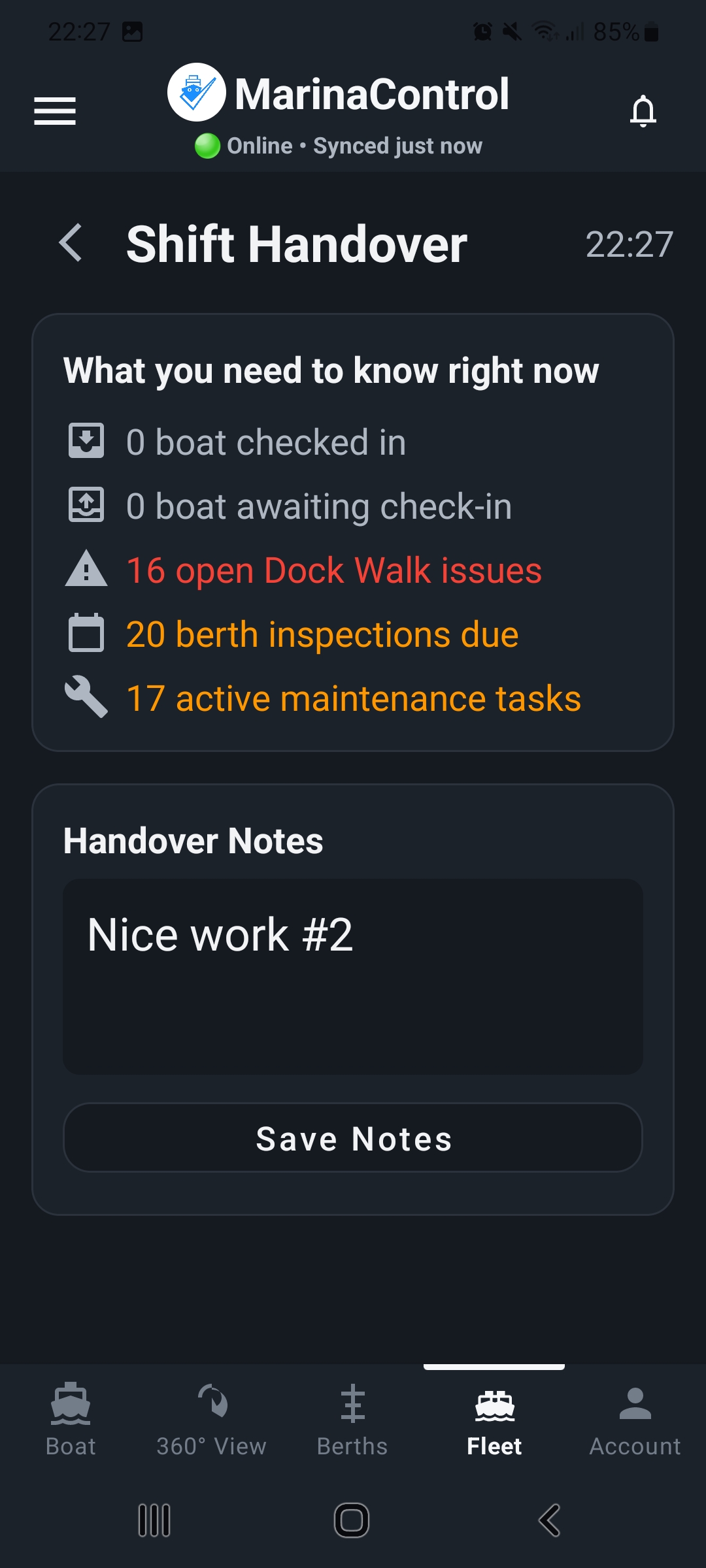
MarinaControl's Shift Handover screen brings together current operational indicators with notes from the marina team.
The handover summary shows boats checked in, boats awaiting check-in, open Dock Walk issues, berth inspections still due and active maintenance tasks.
The operator can then add handover notes for the next shift, preserving information that may not be represented by those operational records alone.
Request a MarinaControl demoWhy connected information matters
Consider a damaged shore-power pedestal identified during a Dock Walk.
The observation itself is only the beginning. Maintenance may be required. The affected berth may need to remain unavailable. An arriving vessel may need another berth. The customer may already have been contacted. A contractor may be expected the following morning.
If those facts are distributed across different conversations and records, the incoming shift has to reconstruct the situation.
When the operational records remain connected, the handover can concentrate on what has changed and what happens next.
CONNECTED MARINA OPERATIONS
Dock Walk → issue → maintenance → handover → continued action
The handover is not the end of an operational process. It is the point at which responsibility and context continue across a change of shift.
Shift handover and the marina opening process
Shift handover and marina opening are closely related, but they answer different operational questions.
The handover explains what the outgoing team knows and what remains outstanding. The opening process establishes whether the marina is ready for the next operating period.
Used together, they help prevent the start of a new shift from becoming an information reset.
For a structured review of daily operational readiness, see the Marina Opening Checklist .
Shift handover and Dock Walk
Dock Walk observations are particularly important during handover because an inspection can identify issues whose resolution extends beyond the shift in which they were discovered.
An unresolved berth, pontoon, utility or access issue should remain visible to the people who inherit responsibility for the operation.
For the inspection process itself, see the Marina Dock Walk Checklist .
The wider principle
Shift changes should not create gaps in operational understanding.
The incoming team needs to know what the marina looks like now, what remains unresolved and where its attention should go next.
Structured data provides part of that picture. Human knowledge provides another part.
The strongest handover connects both.
Operational note: This resource provides general operational guidance and is not a substitute for a marina's own risk assessments, shift procedures, safety management arrangements, emergency procedures or applicable legal and regulatory requirements. Marina operators should adapt their handover process to their facility, staffing model, services, local conditions and operational responsibilities.